Denim Production Workflow Tiered QC Protocols Cross Border Shipping Risk Control for B2B Brands
Denim Production Workflow Tiered QC Protocols Cross Border Shipping Risk Control for B2B Brands
Introduction: Why Process-Driven Production & QC Determines Denim Brand Longevity
For B2B apparel buyers, independent streetwear founders, and private label denim operators, the biggest supply chain pain point is not insufficient design creativity, but unstable repeatable production output. Many brands invest heavily in developing unique denim styles only to face inconsistent craftsmanship, undetected process defects, and unmanaged shipping risks that ruin seasonal inventory plans. Most post-order disputes, consumer return rates, and brand reputation losses stem from unstandardized mid-stream production operations and superficial quality inspection mechanisms.
Unlike generic apparel manufacturing, denim production involves unique textile characteristics, multi-stage physical and chemical processing, and high-precision assembly requirements. Every procedure from raw fabric pre-treatment, panel cutting, structural assembly, and post-finishing to final sorting directly determines retail product qualification rates. Meanwhile, cross-border denim order fulfillment involves exclusive packaging standards, textile shipping compliance, and batch-based logistics management that differ from ordinary garment shipments. Sourcing managers consistently search for standardized denim production workflow for private labels and reliable denim QC protocols for cross-border orders to stabilize long-term brand supply chains.
Raw Fabric Pre-Treatment & Batch Validation Process
Formal denim bulk production does not start with cutting or sewing, but with systematic raw fabric batch validation and pre-treatment. Many mid-tier manufacturers skip targeted fabric conditioning for different denim materials, causing latent quality risks in subsequent processing. Different fabric weights, fiber blends, and weaving structures require exclusive pre-treatment parameters to stabilize texture, tension, and physical activity, a critical step for consistent batch denim production for retail lines.
Professional factory teams conduct roll-by-roll fabric inspection focusing on weaving flaws, tension unevenness, raw color deviation, and edge damage. After visual screening, all qualified fabric batches undergo fixed-tension standing and humidity adjustment to release natural textile internal stress. This professional pre-treatment effectively solves common industry problems such as denim garment twisting after washing and uneven fabric tension causing deformed silhouettes, issues that frequently trouble small-batch custom denim producers.
For blended stretch denim and heavyweight rigid denim, teams record batch-specific fabric activity data and establish exclusive process files. This data serves as the core basis for subsequent pattern adjustment, washing parameter setting, and finished product quality judgment, laying a stable foundation for repeatable custom denim batch production.
Precision Cutting & Batch Panel Management Mechanism
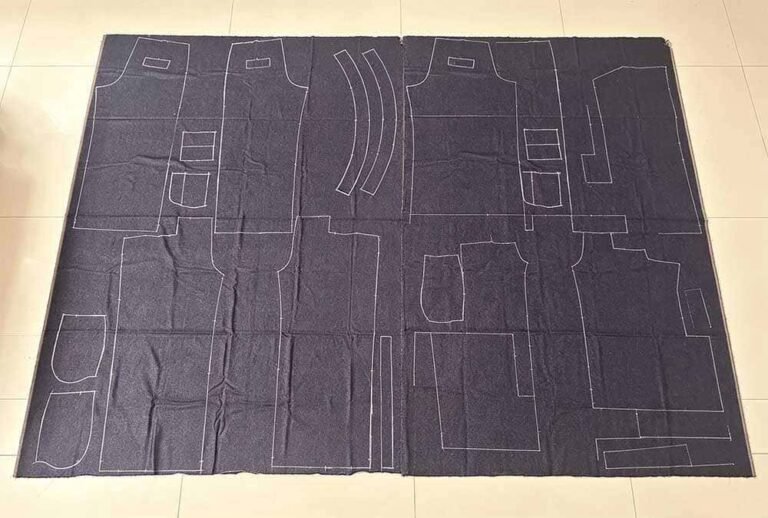
Cutting precision is the core premise of consistent denim assembly quality, yet it is the most easily overlooked link in small-batch production. Many flexible-order factories adopt random layered cutting and mixed-size panel placement, resulting in inconsistent panel sizes, edge burrs, and mismatched batch specifications. These subtle cutting errors amplify during sewing and finishing, forming obvious finished product defects.
Standard industrial denim cutting workflows adopt graded layered spreading and fixed-size batch cutting. According to brand size specification tables and order quantity ratios, operators complete layered spreading with fixed tension and fixed layers to avoid artificial stretching or fabric extrusion. All cut panels are strictly grouped by size, batch number, and fabric roll number, with unified labeling and isolated placement to prevent cross-batch mixing. This standardized management mode effectively improves custom denim cutting precision for small batches and eliminates size deviation caused by human operation.
In addition, professional teams optimize cutting layouts according to fabric characteristics, reducing edge waste while ensuring complete panel texture consistency. This balances production quality and material cost control, suitable for cost-effective denim bulk production for startup brands.
Modular Assembly & Process Locking Sewing Standards
Denim sewing assembly adopts modular segmented production, different from ordinary one-line full-process sewing. Each workstation is responsible for a fixed assembly module including fly assembly, waistband fitting, pocket reinforcement, and bottom seam stitching. Specialized segmented operation unifies worker operation habits and stitch tension standards, fundamentally solving cross-batch denim stitching inconsistency.
For high-tension parts unique to denim garments such as pocket corners, inseams, and waistband connections, the factory implements double reinforcement stitching and fixed-density bartack standards. All stitch types, thread colors, stitch densities, and seam allowances are locked into production process cards, prohibiting arbitrary adjustment by on-site workers. For custom contrast stitching and vintage irregular stitching styles, standardized parameter ranges are formulated to ensure aesthetic unity while retaining design characteristics.
Modular assembly and process locking technology greatly reduce the error rate of manual operation, effectively supporting high-precision custom denim production for designer brands and ensuring that each batch of garments maintains consistent structural durability and visual effect.
Post-Production Finishing & Shape Setting Process Norms
Post-wash finishing is not a simple trimming and ironing process, but a systematic shape-setting procedure that determines denim’s final retail presentation. After industrial washing and drying, denim fabrics have unstable shrinkage rates and wrinkled structures, requiring standardized finishing operations to fix silhouettes.
Professional finishing workflows include full-scale loose thread trimming, targeted partial ironing, overall silhouette shape setting, and hardware fine calibration. Different from ordinary flat ironing, denim professional steam pressure setting targets structural parts such as leg lines, waist arcs, and pocket three-dimensional sense to avoid flat or deformed finished products. At the same time, workers conduct secondary calibration of hardware firmness and position to correct slight displacement caused by washing and drying.
Standardized post-production finishing solves common problems such as uneven denim silhouette shaping and loose hardware after batch washing, ensuring that all finished garments meet unified retail display standards.
Process Embedded Pre-Emptive QC (Before Finished Product Formation)
Excellent denim quality control focuses on prevention rather than post-production rework. The tiered QC system embeds inspection nodes in every key production link to block defects at the source, which is the core difference between industrial-grade manufacturing and workshop-style production. Most B2B buyers prioritize factories with in-process denim quality control systems because pre-emptive inspection greatly reduces batch loss rates.
The first embedded QC node is fabric batch inspection before cutting, focusing on weaving flaws, color difference, and shrinkage stability. The second node is cut panel inspection, checking panel size accuracy, edge smoothness, and batch labeling consistency. The third node is mid-assembly sampling inspection, verifying stitch tension, reinforcement firmness, and panel alignment. The fourth node is post-wash semi-finished product inspection, screening extreme color difference and fabric damage caused by washing.
Through multi-node embedded inspection, most process defects are eliminated before batch completion. This mechanism avoids massive rework and inventory waste, which is crucial for risk-controlled small-batch denim custom production.
Finished Product Graded Inspection & Defect Classification Processing
The final finished product inspection adopts AQL professional grading standards combined with denim exclusive defect classification rules, dividing flaws into critical defects, major defects, and minor aesthetic deviations. This scientific classification avoids two extreme situations: excessive elimination of qualified natural textile traces and leakage of high-risk functional defects.
Critical defects include broken stitching, loose hardware, fabric holes, severe color transfer, and dimensional out-of-tolerance, all of which are directly rejected and excluded from shipment. Major defects include partial uneven stitching and slight fabric stains, which are processed by professional rework and re-inspection. Minor deviations include tiny natural color difference and subtle texture differences, which are sorted and grouped scientifically without affecting retail sales.
After inspection, all qualified products undergo tonal sorting and size grouping to ensure uniform batch shipment effect. This standardized graded inspection process supports high-standard denim quality control for export orders and meets strict European and American retail access requirements.
Batch File Archiving & Repeat Order Quality Consistency Guarantee
A key advantage of professional denim manufacturing is repeatable quality stability for subsequent orders. After each batch of production is completed, the factory completely archives all process data including fabric batch parameters, cutting standards, sewing process cards, washing formulas, and QC inspection reports to form exclusive brand production files.
When brands place repeat orders, all historical standardized parameters are directly invoked to avoid quality deviation caused by different production teams or time differences. This solves the long-term pain point of unstable quality of denim repeat bulk orders and provides continuous quality guarantee for brand seasonal iterative collections.
Denim Exclusive Packaging Standards for Transit Damage Prevention
Denim garments are heavy, hard-textured, and equipped with metal hardware, making them prone to extrusion deformation, surface scratching, and color cross-staining during long-distance transportation. Ordinary universal garment packaging cannot meet denim export standards, which is why professional custom denim export packaging protocols are essential for cross-border orders.
Industrial-grade denim exclusive packaging adopts layered protection: single-piece independent polybag isolation prevents hardware scratching fabric and color cross-transfer between garments; standardized folding specifications avoid long-distance extrusion creases; customized carton hardness and internal spacing settings prevent batch extrusion deformation. At the same time, export cartons adopt unified labeling standards including batch number, size ratio, destination port, and compliance marks to facilitate customs clearance and warehouse entry sorting.
Targeted denim packaging management effectively reduces transit damage rates, protecting brand finished product investment for global cross-border denim shipments.
Scientific Shipping Mode Matching Based on Order Attributes
Different denim order volumes, launch cycles, and market sales rhythms require targeted shipping mode matching. Blindly choosing single sea freight or air freight will either delay launch opportunities or increase unnecessary logistics costs. Professional factories provide data-based shipping matching solutions for B2B denim brands.
Large-batch seasonal inventory orders with sufficient launch cycles prioritize ocean freight, maximizing cost advantages and suitable for seasonal denim bulk inventory shipping. Medium-batch supplementary orders with tight schedules adopt air freight, balancing timeliness and logistics costs, meeting mid-volume denim order fast restock needs. Small-batch trial orders, sample batches, and emergency replenishment adopt international express door-to-door delivery, solving urgent small-batch denim order shipping demands.
The professional logistics team provides real-time transit tracking, customs document collation, and shipment progress feedback throughout the process, avoiding customs detention and delivery delays caused by incomplete compliance materials.
Pre-Shipping Compliance Inspection & Shipment Risk Early Warning
Cross-border denim shipments involve textile safety compliance, commodity coding classification, and import tariff standard verification. Missing compliance inspection before shipment is easy to cause customs clearance failure, cargo detention, and extra penalty costs, seriously affecting brand launch plans.
Before all denim orders are shipped, the team completes compliance self-inspection covering textile safety indicators, hardware material compliance, and export document authenticity. For products sold to EU and North American markets, secondary verification of regional textile regulations is conducted to ensure full compliance with local market access standards. This set of pre-shipping risk control mechanisms effectively avoids cross-border denim order customs clearance risks and ensures smooth arrival of goods.
Conclusion: Systematic Operation Builds Long-Term Denim Supply Chain Stability
The core competitiveness of B2B denim manufacturing lies in systematic, standardized, and repeatable production, QC, and logistics systems. Fine-grained raw material pre-treatment, precision modular assembly, tiered preventive quality control, and denim exclusive cross-border logistics management together eliminate most batch quality and delivery risks in the industry.
For emerging denim brands pursuing long-term development, stable production consistency and controllable shipping risks are more valuable than occasional perfect sample effects. By cooperating with factories with complete process specifications and standardized QC systems, brands can effectively reduce inventory losses, lower after-sales dispute rates, and accumulate stable market reputation in global competition.