Denim Jeans Order Confirmation Workflow Production Pack Creation Through Fabric Cutting
Denim Jeans Order Confirmation Workflow Production Pack Creation Through Fabric Cutting
Introduction
Many apparel brand founders and product developers underestimate the critical sequence of work that unfolds immediately after a denim style is approved and the order is locked in. Most buyers focus their attention on finalizing design references, fit samples, and wash swatches, yet the phase between confirmed order and fabric cutting carries some of the highest hidden risks for delays, fabric variance, fit discrepancies, and unexpected rework. Small missteps during production documentation, yardage calculation, pre-production wash testing, and fabric release can push shipment dates back multiple weeks, add unplanned cost overruns, or create inconsistent garment quality across a full production run.
This article breaks down the standard operational workflow our denim production team follows once a client’s jean order receives formal confirmation. We walk through each task, realistic lead times, common brand pain points, and process controls built to preserve consistency while avoiding unnecessary bottlenecks. Every step described below ties into our framework for predictable garment execution, which you can explore in greater detail at our dedicated pillar page: Reliable Denim Production, QC & Order Delivery Solutions. If you want to learn more about our full operational scope for denim apparel manufacturing, visit our homepage: xiaoxinclothing.com.
For emerging streetwear labels, direct-to-consumer brands, and established apparel lines, understanding this behind-the-scenes sequence helps set realistic timelines, identify where hold-ups commonly emerge, and align internal brand teams with factory workflows before production starts. This is not a pitch for new orders; it is a transparent breakdown of the standard operating procedures our production coordination team executes once an order is formally approved.
Step 1: Production Merchandiser Creates Formal Production Pack Documentation After Order Lock-In
What a denim production pack includes for bulk manufacturing
Once the client signs off on the order and all pre-production sample approvals are finalized, our production merchandiser (merchandising coordinator) begins drafting the full production pack, commonly shortened to “production pack.” This document serves as the single source of truth for every department involved in the jean build: pattern making, fabric testing, cutting room, sewing, wash, and quality inspection.
A complete denim production pack includes graded pattern specs, point of measurement tables, construction notes, hardware specifications, labeling instructions, barcodes, packing requirements, and reference photos of the approved pre-production sample. The merchandiser cross-references every measurement point against the signed-off sample to catch any mismatched notes from earlier sample rounds.
Timeline and common client pain points
This phase typically takes 2 to 3 business days for standard jean styles. More complex styles with non-standard pocket geometry, custom hardware placements, or multi-panel construction may extend this task to 4 business days.
A frequent pain point we observe: brand teams submit last-minute minor spec edits after the production pack has already been drafted. Even a 0.25-inch adjustment to hip measurement or pocket placement requires full document revision and re-validation. Late spec changes at this stage reset the timeline, create version control confusion, and increase risk of error on the cutting table later. Our merchandising team enforces document version tracking to prevent outdated spec sheets from reaching pattern makers or fabric suppliers.
How we keep this step efficient without sacrificing accuracy
The merchandiser maintains a change log embedded directly inside the production pack. Every revision is timestamped, labelled with version numbers, and shared internally only after full cross-check. We avoid manual retyping of full spec sheets where possible, but all critical measurement points are manually verified, not auto-populated, to catch spreadsheet calculation errors before the pack moves to the pattern department.
Step 2: Pattern Maker Calculates Net and Gross Denim Fabric Yardage
Pattern grading and marker layout for yardage estimation
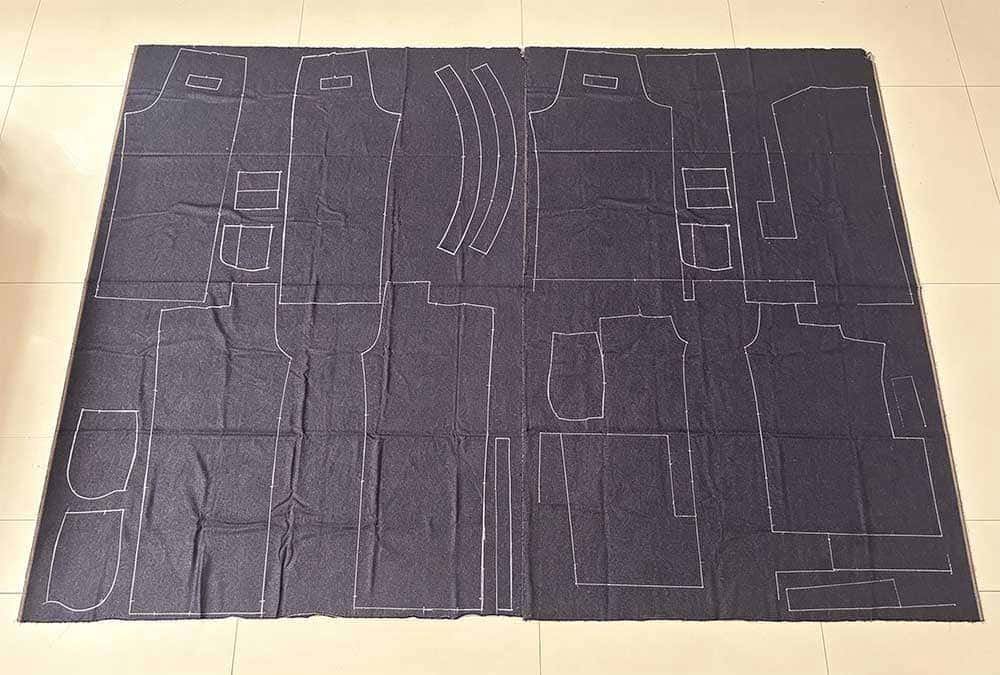
Once the production pack is finalized and internally approved, the document transfers to our pattern department. The pattern maker reviews all graded sizes for the order, builds the digital marker layout, and calculates both net fabric consumption and gross fabric allowance. Net yardage is the raw fabric required to physically cut all jean panels. Gross yardage adds allowances for fabric end bits, edge waste, minor fabric flaws, and pre-production test swatches.
The marker layout arranges all pattern pieces across the fabric width to optimize material utilization. Denim fabric rolls have fixed usable width, and pattern orientation matters greatly. Twill direction on denim cannot be ignored; misaligned grain lines cause twisting legs, inconsistent drape, and fit variation across sizes. The pattern maker must orient every jean panel along the correct twill grain during marker creation.
Timeline and key pain points
Fabric yardage calculation and marker generation normally requires 2 business days for multi-size jean runs. Larger size assortments with extended sizing ranges or plus-size grading can add an extra day to this work.
The most recurring issue brands face: underestimating fabric waste allowance. Many brand teams only budget for net yardage and fail to account for fabric imperfections, test swatch requirements, or end-of-roll waste. When insufficient yardage is ordered, the factory must source additional matching denim, which often introduces shade variation between separate fabric batches. Shade mismatch is one of the top causes of bulk denim order delays and QC hold-ups.
Balancing fabric yield and quality
Our pattern team balances tight marker efficiency with practical grain rules. We can increase marker density to reduce fabric consumption, but we never sacrifice proper twill grain alignment purely to cut material costs. We document the calculated gross yardage and share the figure with the merchandiser, who relays this requirement to the denim fabric supplier to reserve the correct total roll quantity.
Step 3: Merchandiser Coordinates Fabric Swatch Cutting for Pre-Production Wash Testing
H3 Why 1-meter test cuts from every denim roll are mandatory
After yardage calculation is complete, the merchandiser communicates with the denim mill to request a 1-meter cut sample from each fabric roll allocated for the order. This is a non-negotiable quality checkpoint before bulk fabric shipment. Even within the same fabric lot number, individual rolls of denim can show subtle differences in indigo depth, tensile strength, shrinkage rate, and reaction to wash chemistry.
Each 1-meter strip is pulled directly from the start of its assigned roll. These swatches travel to our designated wash facility to replicate the approved bulk wash recipe. Wash technicians run the swatches through the identical wash sequence, including stone wash, enzyme treatment, softener application, and tumble drying that will later apply to the full garment run. After washing and drying, technicians record shrinkage percentage, color loss rate, hand feel, and surface texture.
Timeline and common delays in fabric wash testing
Roll sampling, transit to the wash facility, wash processing, drying, and evaluation usually spans 3 to 5 business days. Transit time between denim mill and wash lab can extend this window if logistics are slow.
Buyers frequently overlook roll-level variance. Many brands assume one lot number guarantees uniform wash results across all rolls. In practice, minor raw fabric differences between rolls can lead to visible shade variation on finished jeans if testing is skipped. When we discover a roll that fails the wash test, we remove that roll from the production allocation before bulk fabric ships, preventing a far larger problem once cutting starts.
Documentation of wash test results
All test swatches are labelled with roll ID, lot number, shrinkage percentage, and post-wash color reading. The merchandiser compiles all test reports and physical swatches, cross-references against the client’s approved wash reference, and only gives final clearance once every roll passes the wash performance benchmark. If any roll fails the wash evaluation, the merchandiser coordinates with the fabric mill to replace that specific roll and repeat the 1m test on the replacement.
Step 4: Formal Bulk Fabric Release and Fabric Shipment to Production Facility
Final approval triggers bulk fabric release
Only after every individual roll’s wash test passes evaluation does the merchandiser authorize the fabric mill to ship the full denim roll consignment to our factory. This is the official release point; bulk fabric will not ship before roll-level wash validation is complete. The fabric mill stacks the rolls and arranges loading for overland transport to our cutting facility.
Upon arrival at our facility, the warehouse team logs each roll, cross-checks roll IDs against our approved list, inspects outer packaging for water damage, and stores denim rolls in climate-controlled storage space. Denim must be kept away from high humidity to prevent premature indigo bleed and moisture-related shrinkage shifts.
Timeline and logistics risks
Fabric shipment from denim mill to our facility generally takes 2 to 4 business days, depending on distance and trucking scheduling. Customs and carrier bottlenecks are rare for domestic fabric movement but can occasionally add hold time.
A common brand pain point: compressing this testing and fabric transit window to shorten overall lead time. Skipping per-roll wash testing to save a few days often creates costly rework later. Shade sorting after garment sewing is far more labor intensive and disruptive than removing a problematic fabric roll before cutting begins.
Step 5: Fabric Inspection and Preparation for the Cutting Room
Pre-cut fabric audit
Before any fabric enters the cutting table, our cutting department performs a full visual inspection of each roll. Operators unroll denim to check for weaving defects, slubs, holes, oil stains, width inconsistency, or uneven selvage. Defect sections are marked and flagged to be excluded from the usable marker area. The team also rechecks roll lot and ID labels to confirm the fabric matches the approved set.
This inspection step normally takes 1 business day once all rolls have arrived and been logged.
Fabric relaxation before cutting
Raw denim fabric retains tension built up during mill winding. If cut immediately upon arrival, fabric will relax after cutting and washing, causing garments to shrink unevenly and measurements to drift outside tolerance. We lay denim rolls flat for fabric relaxation, allowing the material to release tension for a defined period before marking and cutting. Relaxation duration is determined by fabric weight, weave density, and pre-tested shrinkage data captured in the earlier wash swatch phase.
Cutting room marker plotting and bulk cutting
After relaxation completes, the cutting technician loads the pre-approved digital marker to the cutting system. Panels are cut following the grain direction defined by the pattern maker. Cut jean components are bundled by size, labelled, and moved to sewing preparation.
Timeline and cutting-stage risks
Fabric relaxation + inspection + bulk cutting for a standard jean order takes 3 to 6 business days, depending on total order quantity and number of sizes.
The main risk at this stage is skipping proper fabric relaxation. Brands sometimes push to rush the cutting schedule, unaware that tension-locked denim creates inconsistent garment measurements post-wash. Our production team adheres to the relaxation schedule established from the 1m wash test data, even when clients request accelerated timelines.
Conclusion
The sequence from production pack creation all the way through fabric cutting is the foundational phase that defines the quality and reliability of finished denim garments. Each checkpoint exists to mitigate common denim manufacturing risks: spec misalignment, miscalculated yardage, roll-to-roll wash variation, fabric tension shrinkage, and uncaught fabric defects.
Transparent production coordination, per-roll wash swatch testing, grain-aware pattern marking, and structured fabric relaxation are not optional extras; they are standard controls to keep denim orders on track and reduce rework after bulk production starts. All of these operational controls sit within our broader framework for consistent order fulfillment and quality oversight. When brand teams understand this workflow, they can set realistic lead times, avoid last-minute spec revisions, and collaborate more effectively with production teams through every phase of jean manufacturing.